How long does it take to learn trading?
The honest answer: there is no single number. Anyone who promises a specific timeframe is oversimplifying. What we can say is what the pace depends on and how to speed it up.
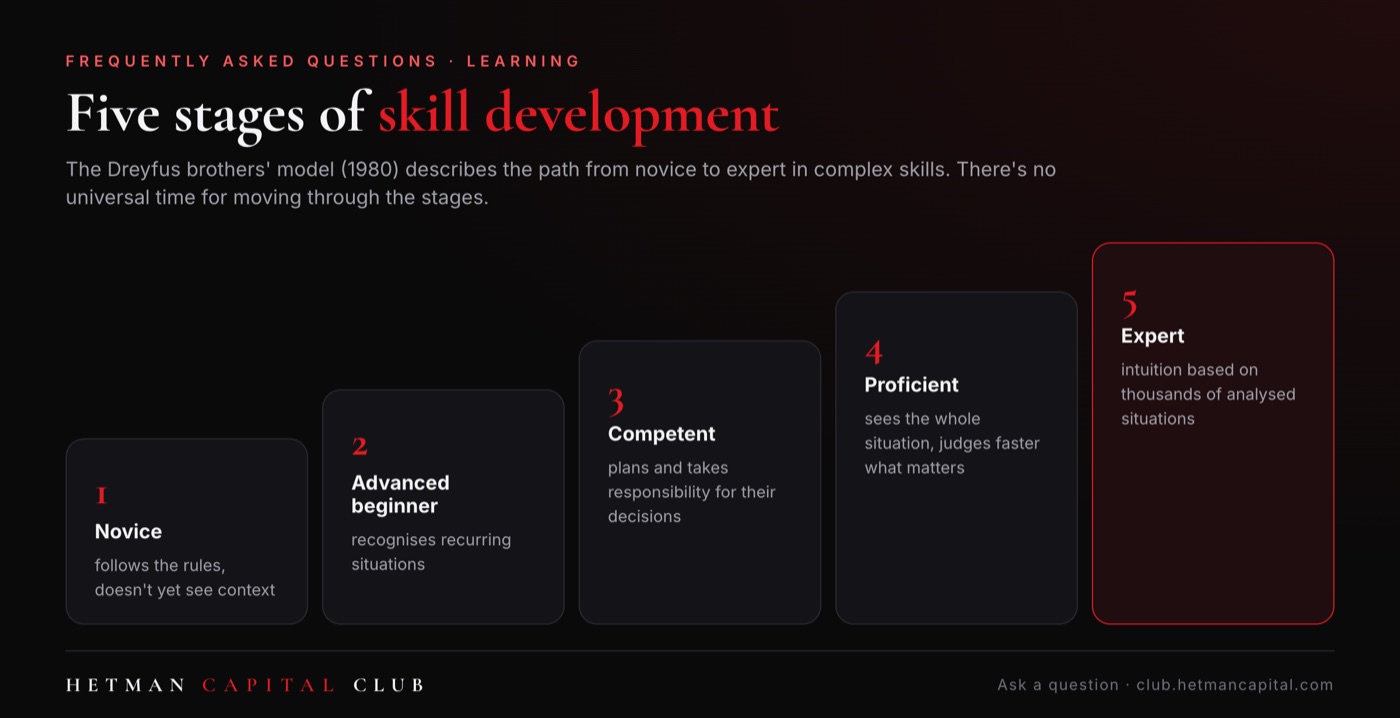
Stages of development
The Dreyfus model (1980) describes the path from novice to expert in complex skills: the novice sticks to rules, the advanced beginner recognises recurring situations, the competent performer plans and takes responsibility for decisions, the proficient performer sees the whole situation, and the expert acts on intuition built from thousands of analysed cases.
The “10,000 hours” myth
The popular 10,000-hour rule is a simplification of Anders Ericsson's research. A meta-analysis by Macnamara, Hambrick and Oswald (2014) found that the amount of deliberate practice explains only part of the differences in skill, and its importance varies between fields. It's not just the number of hours that counts, but their quality.
What speeds up learning
- deliberate practice: working on one skill at a time with feedback (📖 Order flow encyclopedia #16)
- a journal and reviews: reflection turns experience into lessons (🧠 Trader psychology)
- feedback: 📒 Trader's journal, and questions here
- your form: sleep and stress regulation affect how fast you learn (💪 Fitness and routine)
What slows it down
- constantly changing methods and tools
- learning only live, without replays
- judging progress only by short-term results
♛ Hetman Terminal: order flow tools in your browser
Liquidity heatmap, DOM, footprint, Volume Profile, TPO and cumulative delta – the same kind of tools as in Sierra Chart, ATAS or Bookmap, live in your browser, with no software to install. See screenshots of all the tools →
♛ The Hetman Terminal is part of Club: live for Dow Jones from the Bishop plan, 6 markets (Dow Jones, S&P 500, Nasdaq, gold, crude oil, Bitcoin) and automatic detection of order flow events from the Rook plan. A session on the ♛ Hetman Index (training, simulated data) in the full panel comes with the Knight plan and above. Compare the plans →
Sources
- Dreyfus S. E., Dreyfus H. L. (1980). A five-stage model of the mental activities involved in directed skill acquisition. University of California, Berkeley.
- Macnamara B. N., Hambrick D. Z., Oswald F. L. (2014). Deliberate practice and performance in music, games, sports, education, and professions: a meta-analysis. Psychological Science.
Educational content, not financial, legal or tax advice.