Lamborghinis by the hour and prop money: how “educators” sell fake wealth

An expensive car outside a villa, a watch on the wrist, a stack of banknotes on the table and a pool in Dubai in the background. Underneath: “Want to live like this? Join my VIP group.” In trading, this image sells courses, signals and “account management” better than any chart. Yet almost every element of it can be rented, borrowed or faked, often for a fraction of what it looks like.
The elements that can be rented or faked
- The car: sports car rental firms rent them by the day and, in many cities, by the hour, including for photo shoots. One afternoon provides enough material for a month of posts.
- The watch: borrowed for the shoot, rented or a replica. In a phone photo, a good-quality fake is practically indistinguishable from the original.
- The villa and the holidays: rented for a few days through accommodation sites, with photos shot “in stock” and then posted for weeks as everyday life.
- The private jet: there are photo studios with a mock-up private jet interior, rented by the hour. A photo next to a real plane can also be taken on the apron without flying anywhere.
- The cash: prop money from film sets is legal to sell and usually carries small print saying it's for film use, invisible in a photo. Add a stack of real banknotes borrowed for an hour.
- The people in the shot: hired models, and a “team” and “students” at events who are playing a role.
- Transfers and balances: screenshots from a banking or exchange app, which can be edited or generated. I cover fake platform results separately in the article Fake MetaTrader results.
What it's all for: the sales funnel
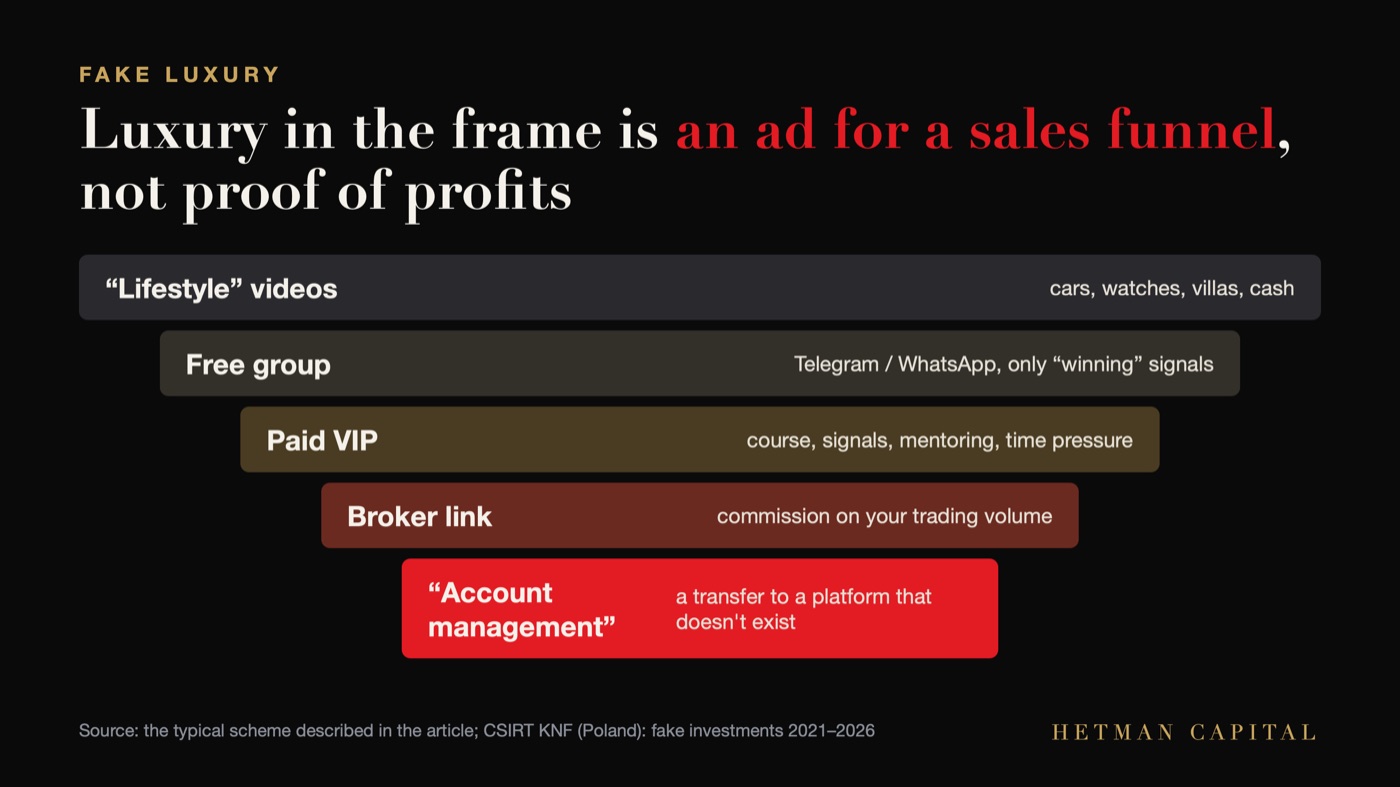
Luxury in the shot isn't proof of trading profits. It's an advert for a product. The typical path looks like this:
- Short videos of “the lifestyle” with a promise of financial freedom.
- A free Telegram or WhatsApp group that shows only the “winning” signals.
- A paid tier: a course, a VIP group, mentoring, often with time pressure.
- A link to a broker that pays the “educator” a commission on your trading volume, or “account management”.
- At the end there's sometimes plain fraud: a transfer to a “platform” that doesn't exist, followed by “loss recovery” for an extra fee.
The money for that lifestyle, if it exists at all, more often comes from the funnel (courses, subscriptions, broker commissions) than from trading. Someone who really makes money in the market doesn't need your subscription or your trading volume at a particular broker.
What the regulators say
In 2025 the Polish regulator (UKNF) published “Finfluencer – good practices and risks” and warns against investment decisions based on a single creator's content. Every year CSIRT KNF reports thousands of fake investment profiles and ads for blocking, often using the images of well-known people and promising quick profits (data in the article KNF warnings and trading). In Poland, recommendations tailored to a specific person are investment advice, which requires a KNF licence.
How to tell education from a sales funnel
| Educator | Sales funnel |
|---|---|
| shows the market and explains why things happen | shows cars, watches and account balances |
| talks about risk and losses, including their own | talks only about profits and “freedom” |
| doesn't hand out ready-made signals to copy | sells signals and “sure entries” |
| doesn't need your account at a particular broker | requires an account opened through their link |
| answers publicly, in the chat or the comments | moves the conversation to private messages |
A quick 5-question test
- Does the content show the market (charts, data, explanation) or mostly a lifestyle?
- Does this person earn from your trading volume (a broker affiliate link)?
- Do they show losses and risk, or only wins?
- Is the firm you're asked to send money through in the register of the KNF or another EU regulator?
- Does someone message you first and push you to decide quickly?
How I approach this
I don't show cars or watches, because they have nothing to do with the market. On the live stream I teach order flow: the order book, the footprint and the volume profile on the Hetman Index – a training instrument with simulated data (I don't show exchange quotes, because they are licensed). I talk about risk, I don't give signals and I have no affiliate links to brokers. If you want to see what an ordinary trader's day looks like, this is it: a few monitors, a daily plan and a lot of waiting.
Frequently asked questions
Where do trading “educators” get the expensive cars in their photos?
Often from rental firms: sports cars are rented by the day and, in many cities, by the hour, including for photo shoots. One afternoon provides material for weeks of posts.
Can the cash in the photos be fake?
Yes. Prop money from film sets is legal to sell and carries small print saying it's for film use, which you can't see in a photo.
How do fake educators really make money?
Mostly from selling courses, VIP subscriptions and signals, and from broker commissions on the trading volume of people who signed up through their links – not from trading.
How can I check whether someone is an honest educator?
Check whether they show the market and the risk or a lifestyle; whether they earn from your trading volume; whether they give signals; whether the firm they send you to is in a regulator's register; and whether they push for a quick decision in private messages.
Educational content, not an investment recommendation or legal or tax advice. I name firms only to show public data from registers and from their own risk warnings.